
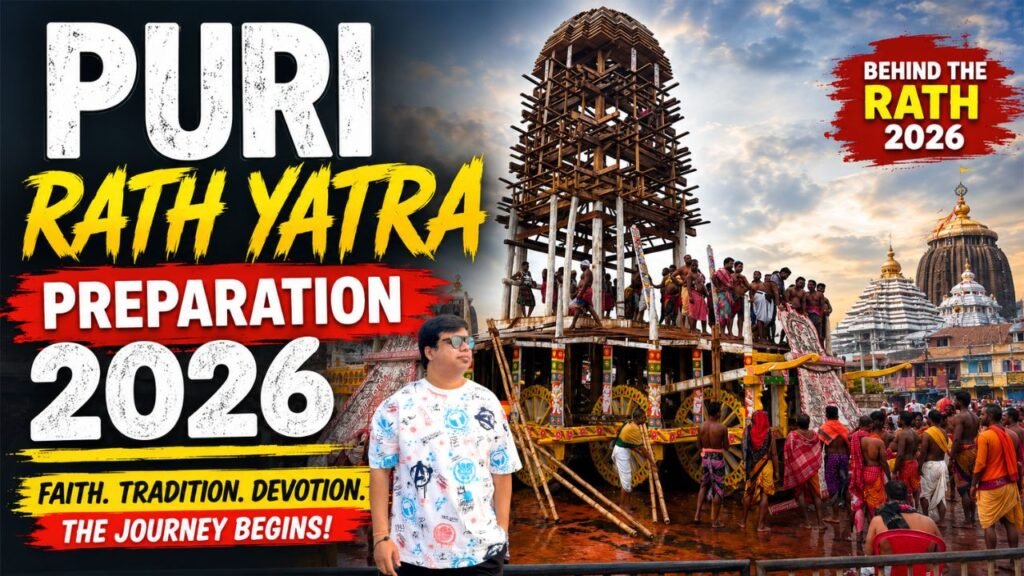
Puri Rath Yatra 2026 (Introduction)
Every July, a coastal town in Odisha pulls off something no other place on earth does. Three wooden chariots, taller than a four-storey building, are hauled through packed streets by hundreds of thousands of bare hands — no machines, no ropes-and-pulleys tricks, just raw human devotion. This is the Puri Rath Yatra, and in 2026 it happens on Thursday, July 16.
Rath Yatra (also called the Jagannath Rath Yatra or Chariot Festival) is the annual procession of Lord Jagannath, Lord Balabhadra, and Devi Subhadra from the Jagannath Temple to the Gundicha Temple, about 3 km away. It matters because it’s the one time each year the deities leave the sanctum and come out to the streets — no ticket, no VIP line, anyone can pull the ropes. That’s the whole point of the festival: for one week, god comes to the people instead of the people going to god.
If you’re planning to be in Puri this July — as a pilgrim, a first-time tourist, or a curious traveler from abroad — this guide covers everything: the full 2026 date calendar, what each ritual means, the three chariots explained, where to stay, how to get there, and a day-by-day itinerary.
Quick Facts:
- Festival: Puri Rath Yatra / Jagannath Puri Rath Yatra 2026
- Main Date: Thursday, July 16, 2026
- Return Journey (Bahuda Yatra): Friday, July 24, 2026
- Festival Concludes (Niladri Bije): Monday, July 27, 2026
- Location: Puri, Odisha, India
- Deities: Lord Jagannath, Lord Balabhadra, Devi Subhadra
- Route: Jagannath Temple → Bada Danda (Grand Road) → Gundicha Temple (~3 km)
- Nearest Airport: Biju Patnaik International Airport, Bhubaneswar (~60 km)
- Nearest Major Railway Hub: Puri Railway Station (direct) / Bhubaneswar Junction
- Entry Fee: Free — open to the public
- Best Viewing Days:July 16 (Rath Yatra) and July 24 (Bahuda Yatra)
What Is Rath Yatra?
Rath Yatra means “chariot journey” in Sanskrit and Odia. It’s the annual festival in which the presiding deities of the Jagannath Temple — Lord Jagannath (a form of Vishnu/Krishna), his elder brother Lord Balabhadra, and their sister Devi Subhadra — are taken out of the temple and placed on three massive, freshly built wooden chariots. Devotees then pull these chariots by hand along Bada Danda, Puri’s Grand Road, to the Gundicha Temple, where the deities “reside” for about a week before making the return journey.
It’s considered the oldest and one of the largest chariot festivals in the world, and it’s the origin of the English word “juggernaut” — coined by European travelers who witnessed the sheer, unstoppable scale of the procession.
Why Jagannath Puri Rath Yatra Is Celebrated
Jagannath Puri Rath Yatra is celebrated to commemorate Lord Jagannath’s annual visit to his birthplace and to Gundicha Temple, believed to be built by Queen Gundicha in his honour. The journey symbolises the divine stepping outside the temple to meet every devotee equally, regardless of caste, religion, or nationality — a rare moment when darshan requires no ritual purity, no priestly mediation, and no barrier at all.
Mythological Significance
According to the Skanda Purana and Brahma Purana, King Indradyumna of Malwa was instructed in a vision to find a sacred log washed ashore at Puri and have it carved into the deities’ forms. The celestial architect Vishwakarma agreed to carve the idols on the condition that no one would watch him work. The impatient queen broke this condition, and Vishwakarma vanished mid-carving — leaving the idols of Jagannath, Balabhadra, and Subhadra without fully formed hands and feet, as they’re worshipped to this day. This “incompleteness” is central to Jagannath worship: the deity is seen as formless divinity taking a simple, approachable shape.
Historical Background
The Jagannath Temple in its current form dates to the 12th century, built under the Eastern Ganga dynasty king Anantavarman Chodaganga Deva. Rath Yatra references, however, appear in scriptures far older, and the tradition of hereditary servitor communities — Daitapatis, Suaras, and others — who build the chariots and conduct rituals has been preserved unbroken for centuries, surviving invasions and political upheaval.
The Story Behind Jagannath Rath Yatra
Spiritual Importance
The Katha Upanishad’s chariot metaphor — the body as chariot, the intellect as charioteer, the soul as passenger — is often invoked to explain Rath Yatra’s deeper meaning: pulling the chariot is a symbolic act of moving the self toward liberation (moksha). Pilgrims believe that pulling the ropes, even once, earns spiritual merit equal to years of temple worship.
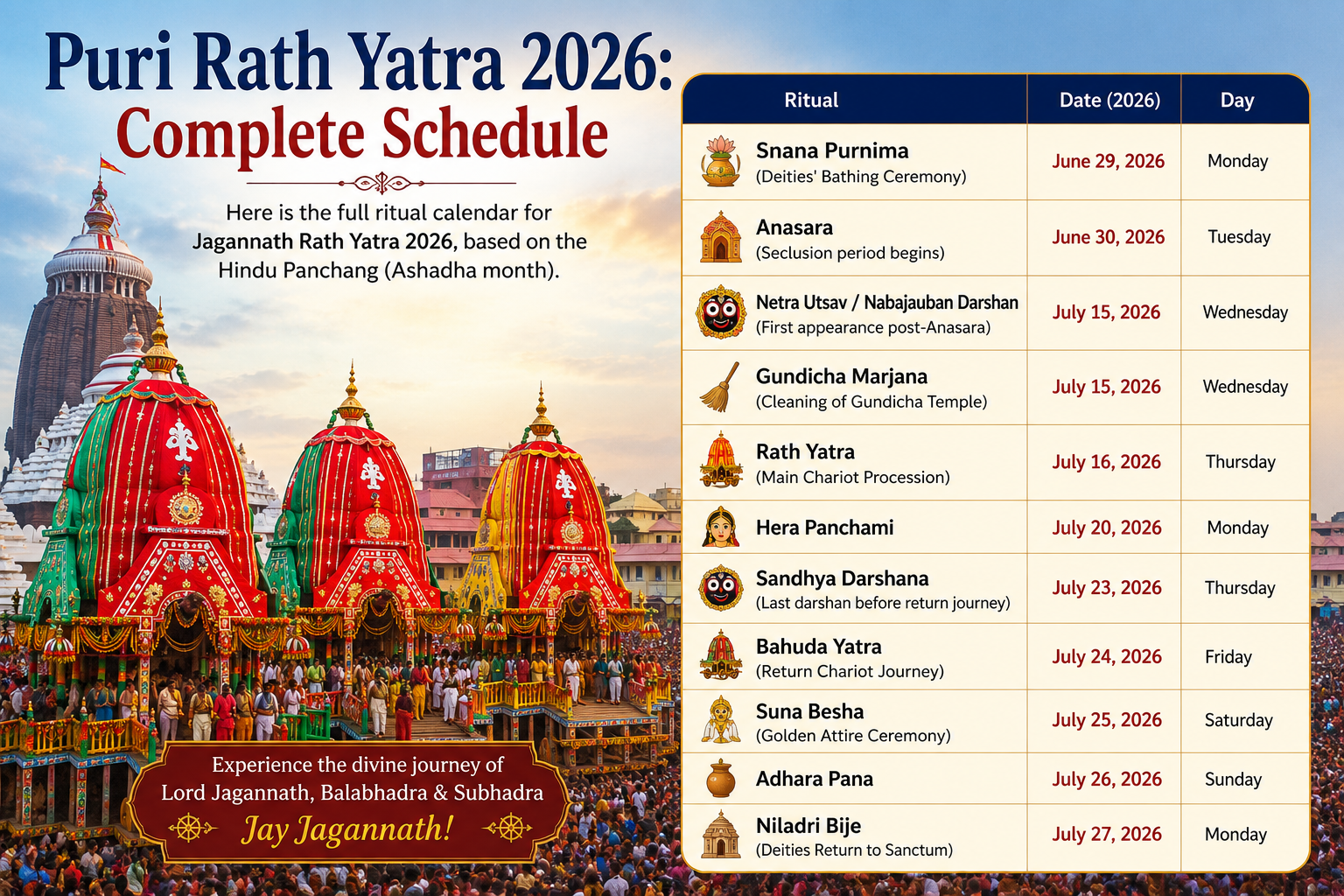
Puri Rath Yatra 2026: Complete Schedule
Understanding Each Ritual
Snana Purnima is the ceremonial bathing of the deities with 108 pots of sacred water drawn from the temple’s Suna Kua (golden well), performed on the full moon day of the Jyeshtha month. This public ritual marks the start of the entire festival cycle.
Anasara is the 15-day seclusion period immediately after Snana Purnima. Tradition holds that the deities fall “ill” from the ceremonial bath and are kept away from public view while undergoing restorative rituals, including repainting. During Anasara, devotees traditionally visit Lord Alarnath in nearby Brahmagiri as an alternative darshan.
Gundicha Marjana is the ritual cleaning of the Gundicha Temple, performed a day or two before Rath Yatra by devotees and even the Gajapati King of Puri, who sweeps the temple with a golden broom (Chhera Pahara) — a powerful symbol that royalty and commoners are equal before Lord Jagannath.
Rath Yatra is the main event: the three deities, seated on their respective chariots, are pulled from the Jagannath Temple along Bada Danda to the Gundicha Temple, roughly 3 km away. The procession typically takes several hours and draws crowds in the lakhs.
Hera Panchami falls on the fifth day after Rath Yatra. Goddess Lakshmi, Lord Jagannath’s consort, is said to visit the Gundicha Temple in a palanquin to check on her husband — and, in a playful ritual re-enactment, symbolically “punishes” his chariot for leaving without her.
Bahuda Yatra is the return journey — the chariots are pulled back from Gundicha Temple to the main Jagannath Temple. It draws crowds nearly as large as the outbound journey and is considered equally meritorious to witness.
Suna Besha happens a day after Bahuda Yatra, when the deities are adorned in elaborate gold ornaments while still seated on their chariots outside the temple — widely regarded as the most photogenic moment of the entire festival.
Adhara Pana is a sweet ritual drink (a mix of curd, milk, sugar, and spices) offered to the deities atop the chariots the day after Suna Besha.
Niladri Bije marks the deities’ formal return into the temple sanctum, closing the festival cycle. Folklore holds that Goddess Lakshmi initially denies Lord Jagannath entry, relenting only after he offers her a rasagolla — often cited as the mythological origin of the sweet.
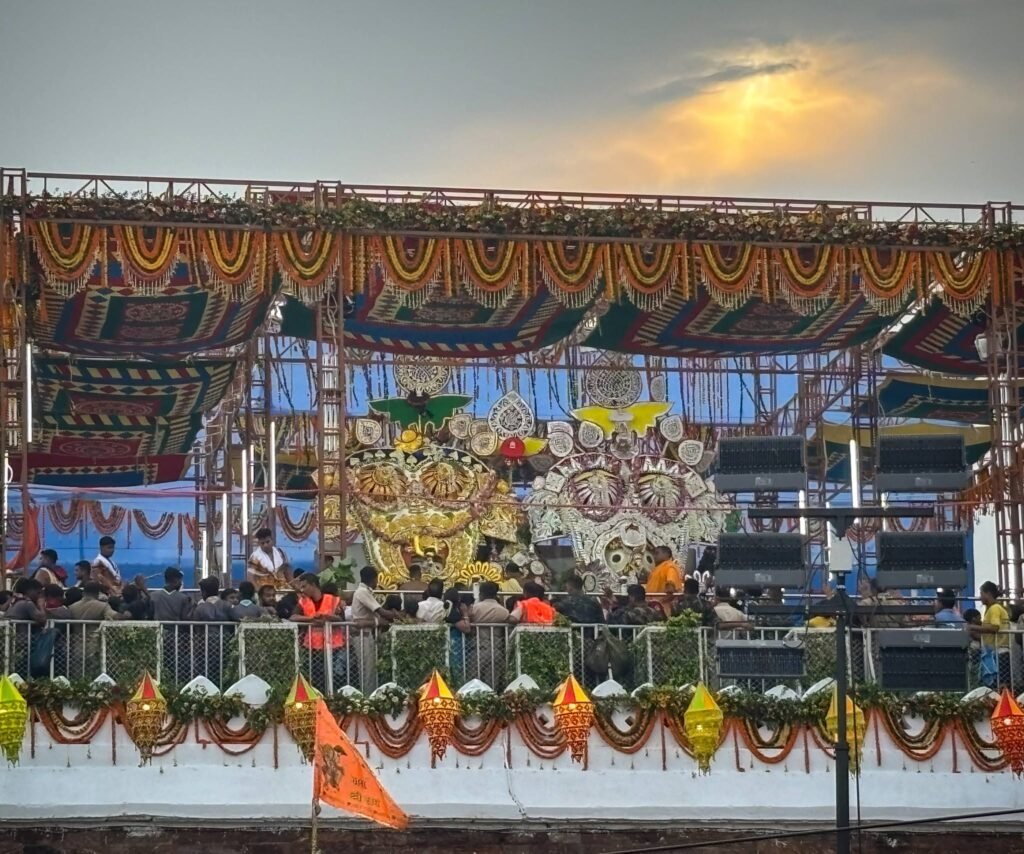
The Three Chariots: Nandighosha, Taladhwaja & Darpadalana
Each year, all three chariots are built entirely from scratch by specialist carpenters, using no nails — only wooden pegs and joints — starting on Akshaya Tritiya, roughly two months before the festival.
Nandighosha — Lord Jagannath’s Chariot
- Height: ~45 feet
- Wheels: 16
- Colour: Red and yellow canopy
- Deity: Lord Jagannath
- Interesting fact: Also called Chakradhwaja, it carries a carved Garuda at the front and is drawn by four white wooden horses. It’s traditionally the first chariot to move and is pulled with the thickest rope, called Shankhachuda.
Taladhwaja — Lord Balabhadra’s Chariot
- Height: ~45 feet
- Wheels: 14
- Colour: Red and green canopy
- Deity: Lord Balabhadra
- Interesting fact: Named after the palm tree (tala) emblem on its flag, symbolising strength. It’s positioned in the middle of the procession.
Darpadalana (Devadalana) — Devi Subhadra’s Chariot
- Height: ~44.6 feet
- Wheels: 12
- Colour: Red and black canopy
- Deity: Devi Subhadra
- Interesting fact: The smallest of the three chariots, it travels last in the procession and is considered the “protector” chariot, its name translating roughly to “pride-destroying.”
Why Jagannath Rath Yatra Is Unique in the World
No other religious festival combines these elements at this scale: chariots rebuilt entirely from raw wood every single year, a public procession with zero entry restrictions by faith or nationality, and an unbroken ritual lineage tracing back over a thousand years. It’s also one of the only major Hindu festivals where the deities physically leave the sanctum and travel among crowds on open streets — most temple traditions bring devotees to the deity, not the other way round. Add to that the sheer physical scale: chariots taller than most buildings on the route, pulled by nothing but human effort, watched by well over a million people across the festival week.
Complete Puri Travel Guide
How to Reach Puri
By Train:
Puri has its own railway station, well connected to Kolkata, Delhi, Mumbai, Chennai, Bengaluru, and Bhubaneswar. From Kolkata, direct trains such as the Puri Express and Shalimar–Puri routes take roughly 7–8 hours. During Rath Yatra, Indian Railways typically runs special festival trains — book tickets 2–3 months in advance as demand spikes sharply.
By Flight
The nearest airport is Biju Patnaik International Airport in Bhubaneswar, about 60 km from Puri (roughly 1.5–2 hours by road or train). Bhubaneswar has regular domestic connections from all major Indian metros, plus a handful of international routes.
By Road
Puri is well connected by national highway to Bhubaneswar (~65 km) and Konark (~35 km). State buses, private coaches, and taxis run regularly; if you’re driving in during festival week, expect diversions and parking restrictions near the temple area — plan to park outside the core zone and walk in.
Where to Stay in Puri
Budget Hotels:
Options: Hotel Sea Queen, Hotel Nilachal, OYO/budget lodges, Airbnb
Approx. Price Range (per night): ₹800 – ₹2,000
Mid-Range Hotels:
Options: Mayfair Heritage, Hotel Lotus Eco Beach Resort, Toshali Sands, Victoria Club
Approx. Price Range (per night): ₹3,500 – ₹7,000
Luxury Hotels:
Options: Mayfair Waves, Trident Gopalpur (near-region), luxury beachfront resorts
Approx. Price Range (per night): ₹8,000 – ₹20,000+
Dharamshalas:
Options: Odisha Bhawans, Jagannath Sevashram, various temple trust guesthouses
Approx. Price Range (per night): ₹300 – ₹1,000
NOTE: Book at least 2–3 months ahead. Hotels within walking distance of Grand Road sell out first, and last-minute rates can triple during festival week.
What to Expect During Rath Yatra
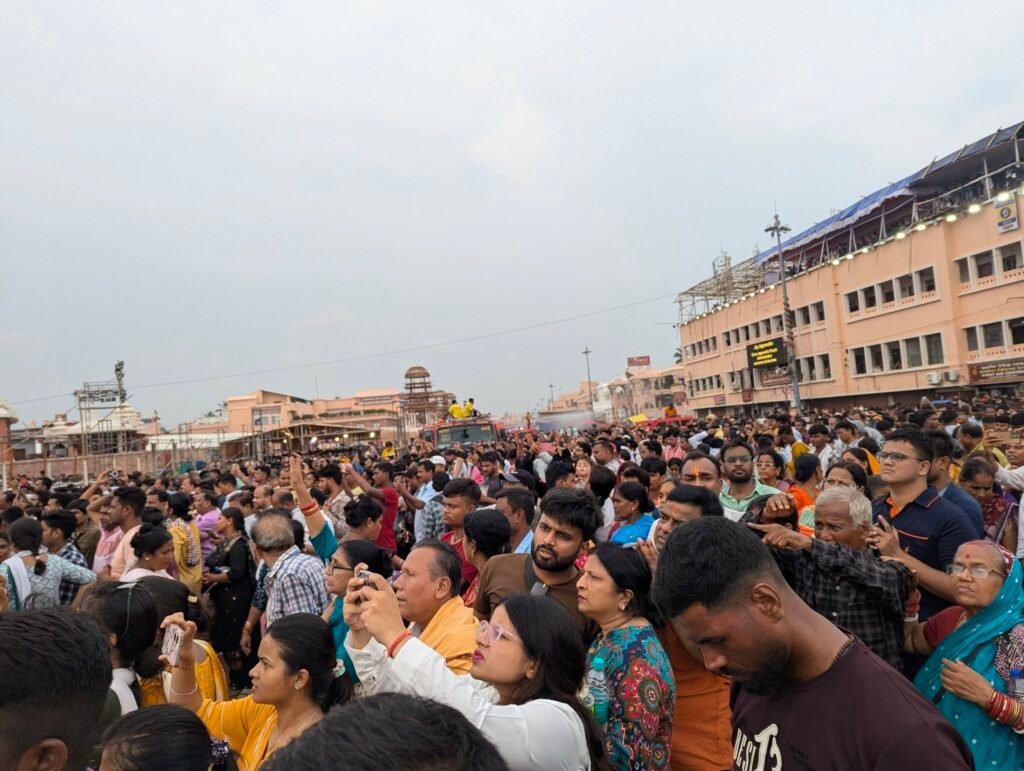
Crowd size runs into the lakhs (hundreds of thousands) on Rath Yatra day itself, with the biggest crush near the Lion’s Gate and Grand Road. Security is heavy — Odisha Police, paramilitary units, CCTV surveillance, and designated barricaded viewing zones are standard. Mobile networks get congested in peak hours; keep an offline map and a physical note of your hotel address. Weather in mid-July is hot, humid, and prone to sudden monsoon showers — carry light cotton clothing and a compact raincoat rather than a large umbrella (umbrellas are impractical in dense crowds).
Dress code: modest, comfortable clothing is expected, especially near temple premises — avoid shorts or sleeveless outfits if you plan to enter temple-adjacent areas. Photography: allowed in public procession areas, but strictly prohibited inside the main Jagannath Temple sanctum. Temple restrictions: the Jagannath Temple’s inner sanctum is open only to Hindus; this restriction does not apply to the outdoor chariot procession itself, which is open to everyone.
Practical Travel Tips
- Best viewing locations: Upper floors of buildings/hotels along Bada Danda (Grand Road), the Lion’s Gate area, and designated public galleries set up by the temple administration.
- Safety advice: Stick to marked pedestrian zones, avoid trying to touch the chariots in the densest crush, and agree on a family meeting point in case of separation.
- Senior citizen tips: Choose a hotel room with a Grand Road balcony view rather than standing in crowds; carry essential medication and a printed ID.
- Family travel tips: Keep children within arm’s reach at all times during the procession; consider watching from a rooftop vantage point rather than street level with younger kids.
- What to carry: Water bottle, ORS sachets, light raincoat, sunscreen, power bank, cash in small denominations, printed hotel address.
- Common mistakes to avoid: Arriving in Puri the same morning as Rath Yatra (roads close early), assuming mobile data will work reliably, underestimating July humidity, and not booking accommodation until the last minute.
Nearby Attractions to Combine With Your Trip
- Golden Beach, Puri — the main city beach, lively and walkable from most hotels.
- Jagannath Temple — the 12th-century main temple; outer areas open to all, sanctum restricted to Hindus.
- Gundicha Temple — the chariot procession’s destination, quieter to visit outside festival days.
- Narendra Tank — a scenic temple tank associated with the Chandan Yatra festival.
- Konark Sun Temple — a UNESCO World Heritage Site, about 35 km from Puri.
- Chilika Lake — Asia’s largest brackish water lagoon, known for migratory birds and dolphin sightings, roughly 50 km away.
- Raghurajpur Heritage Village — a crafts village famous for Pattachitra painting, near Puri.
- Pipili — famous for appliqué handicrafts, en route between Puri and Bhubaneswar.
Suggested 3-Day Puri Rath Yatra Itinerary
Day 1 (July 15 — Arrival & Preparation)
Arrive in Puri by afternoon, check into your hotel, and take an early evening walk along Grand Road to scope your viewing spot for the next day. Visit Golden Beach at sunset.
Day 2 (July 16 — Rath Yatra Day)
Reach your chosen viewing point by early morning — crowds build fast. Watch the chariots depart from Jagannath Temple and follow the procession (or stay in one spot) as they move toward Gundicha Temple. Rest in the afternoon; the procession often runs into the evening.
Day 3 (July 17 — Exploration Day)
Visit the Jagannath Temple’s outer precincts, Gundicha Temple, and Narendra Tank in the morning. In the afternoon, take a short trip to Konark Sun Temple or Raghurajpur Heritage Village before departure.
Extending your trip? Add a day for Chilika Lake, or stay through Bahuda Yatra (July 24) if your schedule allows — the return journey is just as spectacular and considerably less crowded than the outbound leg.
Travel Checklist
- Train/flight tickets booked 2–3 months in advance
- Hotel confirmed with Grand Road or rooftop view
- Comfortable, modest, breathable clothing
- Light raincoat (not an umbrella)
- Power bank + offline maps downloaded
- Water bottle, ORS, basic first-aid kit
- Cash in small denominations
- Printed copy of hotel address and ID
- Family/group meeting point agreed in advance
- Sunscreen and a hat for daytime crowds
Frequently Asked Questions
What are the Rath Yatra 2026 dates?
The main Puri Rath Yatra 2026 procession takes place on Thursday, July 16, 2026. The festival cycle runs from Snana Purnima on June 29 through Niladri Bije on July 27, 2026.
Why is Jagannath Rath Yatra celebrated?
It commemorates Lord Jagannath’s annual journey to Gundicha Temple, symbolising the divine stepping out to meet every devotee equally, without caste, faith, or status restrictions.
Can non-Hindus enter Jagannath Temple?
The inner sanctum of the Jagannath Temple is restricted to Hindus. However, the Rath Yatra procession itself takes place on public streets and is open to devotees and tourists of all backgrounds.
Is Rath Yatra free to attend?
Yes, watching the chariot procession on Bada Danda is completely free and open to the public. Some hotels and private viewing galleries charge for premium vantage points.
Which day is best to visit for Rath Yatra 2026?
July 16 (main Rath Yatra) offers the biggest spectacle, while July 24 (Bahuda Yatra) offers a similar experience with noticeably smaller crowds.
How long does Rath Yatra last?
The full ritual cycle spans about a month, from Snana Purnima in late June to Niladri Bije in late July. The core festival period most tourists focus on runs from July 15 to July 27, 2026.
What is Bahuda Yatra?
Bahuda Yatra is the return chariot journey, when the three deities travel back from Gundicha Temple to the main Jagannath Temple, held on July 24, 2026.
What is Niladri Bije?
Niladri Bije is the concluding ritual of Rath Yatra, marking the deities’ formal return into the Jagannath Temple sanctum, held on July 27, 2026.
What is Hera Panchami?
Hera Panchami is a ritual on the fifth day after Rath Yatra, when Goddess Lakshmi is believed to visit Gundicha Temple in search of Lord Jagannath, falling on July 20, 2026.
Which train is best from Kolkata to Puri?
Direct trains such as the Puri Express and Shalimar–Puri services connect Kolkata to Puri in roughly 7–8 hours; book well ahead of the festival period.
What is the best hotel near Rath Yatra?
Hotels along or near Grand Road (Bada Danda) offer the best procession views; mid-range options like Mayfair Heritage and beachfront resorts like Toshali Sands are popular choices, but book 2–3 months in advance.
Is Rath Yatra safe for solo female travelers?
Yes, with standard festival-crowd precautions — stick to well-lit, marked areas, avoid the densest crush points, and keep valuables secure given the scale of the crowds.
Do I need to book accommodation in advance?
Yes — Puri hotels fill up 2–3 months ahead of Rath Yatra, and last-minute rates rise sharply.
What should I wear to Rath Yatra?
Light, breathable, modest clothing suited to hot and humid weather, with comfortable walking footwear for standing in crowds for extended periods.
Is photography allowed during Rath Yatra?
Photography is allowed in the public procession areas but strictly prohibited inside the Jagannath Temple’s inner sanctum.
Puri Rath Yatra 2026 Preparation Vlog
Always confirm shared Sumo rates and local homestay options with local shopkeepers before booking high-priced online alternatives. Local recommendations are your best bet for a true, budget-friendly experience!
Subscribe to get weekly budget guides directly to your inbox.